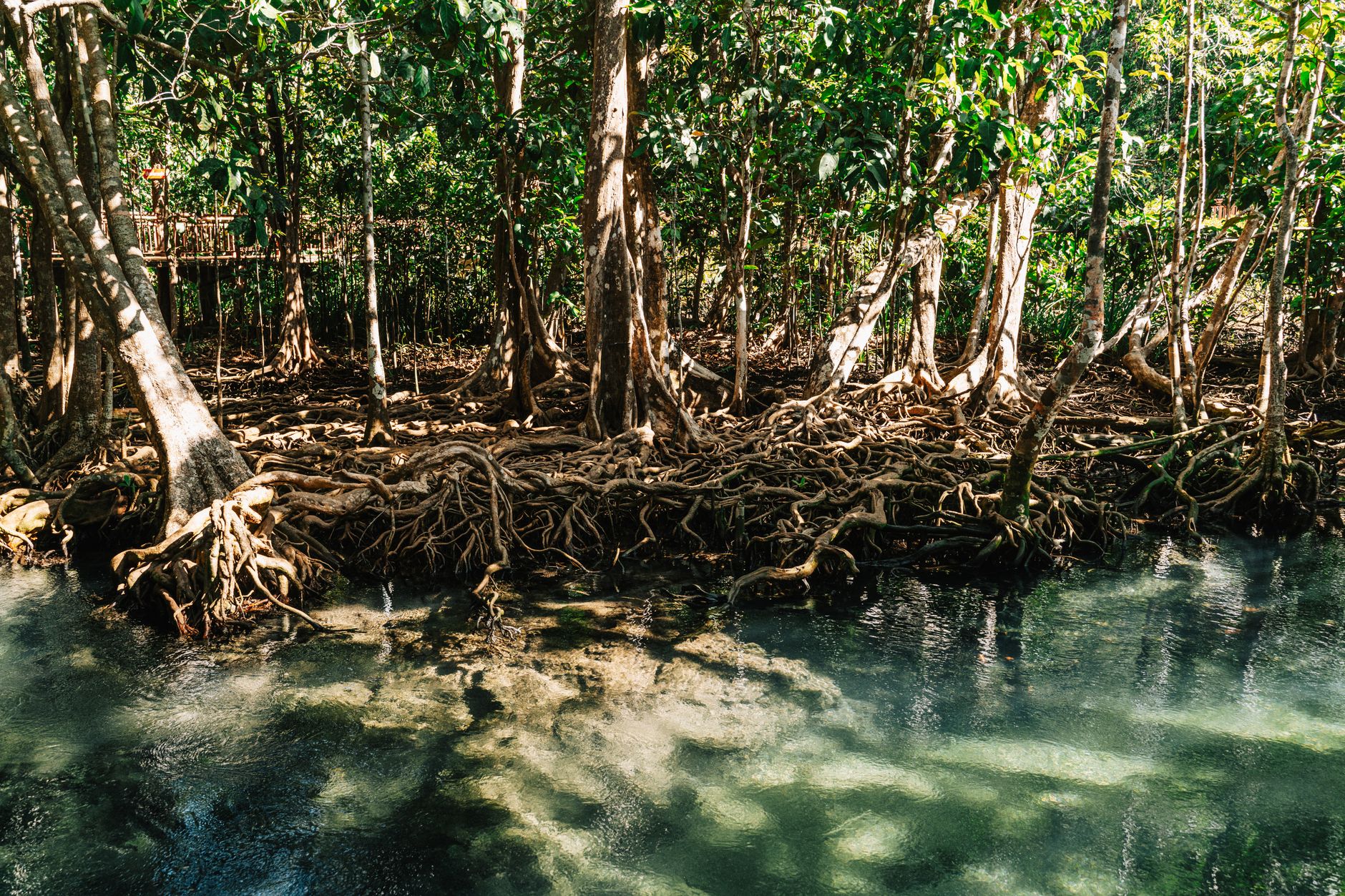
Mangrove Series V Beyond the Light 1 does something the earlier works in this series resisted: it turns away from the light entirely. Where Mangrove Series IV Into the Light drew the eye toward filtered sun breaking through root and canopy, this fifth instalment pushes deeper, past the edge where photons still reach the silt. The result is a work that asks what ecological art looks like when it stops celebrating and starts reckoning.
What the work shows
The composition holds the viewer inside a mangrove interior rather than at its threshold. Roots press from every direction, their forms tangled and partially dissolved by the absence of strong directional light. The palette is cooler here: deep greens bleed into grey-brown, and the water surface, where it appears, reflects very little. It doesn't feel like a dead space. It feels like a space that operates on its own schedule, indifferent to visibility.
Mangrove Series V Beyond the Light 1 builds on the ecological logic the series has developed across its five iterations. Mangroves don't exist for the light at their edge. Their real work happens in the oxygen-poor sediment underneath, in the salt-filtering membranes of their roots, in the brackish water column that most species won't tolerate. This work makes that invisible biology feel present.
The series as a sustained ecological argument
A series of five works across a single ecosystem is a commitment, not a stylistic exercise. Each instalment in the Mangrove Series has shifted its vantage: from the outer root system, to the aerial perspective, to the tidal fluctuation, to the light breaking inward, and now to the space beyond that light. It's a kind of ecological portraiture that respects the complexity of its subject by refusing to summarise it in a single image.
The GreenWay Art Prize has consistently supported artists who take this kind of sustained, iterative approach to ecological subject matter. A single painting of a mangrove can be beautiful. Five paintings that trace a complete perceptual journey through one ecosystem make a different kind of claim about attention, about what it takes to actually know a place.
Why darkness matters in ecological art
Ecological art frequently reaches for colour and clarity. That's understandable. Vivid works attract viewers, and beauty has always been one route into environmental concern. But Mangrove Series V Beyond the Light 1 proposes something harder: that the parts of an ecosystem we can't see clearly are exactly the parts that need our attention.
Australia's east coast mangroves have faced pressure from coastal development, altered sediment flows, and rising sea levels. Much of that pressure is invisible at the human scale. You can walk past a mangrove forest and see only the outer fringe of prop roots and pneumatophores poking from the mud. The interior, the dark interior this work inhabits, is where the system is either thriving or failing. This painting insists you stay there long enough to feel it.
For collectors drawn to works that engage with coastal ecology at depth, this piece sits alongside Alien mangroves, a work that approaches the same intertidal habitat from a completely different angle, treating mangroves as something genuinely strange and worthy of re-examination.
Light as a structuring absence
What makes Mangrove Series V Beyond the Light 1 technically interesting is how it handles the absence it promises in its title. The artist doesn't simply darken the canvas. The light that doesn't arrive is still somehow implied: in the directionality of forms, in the way roots angle toward a source that's been left behind. You feel the light as a structural force even though it isn't there. That's a difficult thing to paint. It requires understanding the illuminated version of the scene well enough to describe its negation convincingly.
The Light and shade on the GreenWay paintings 1-6 series explores a related tension across the GreenWay corridor, tracking how ecological spaces change as light shifts across a day. Seen together, these two sustained series suggest that light, or its absence, is one of ecological art's most productive organising principles.
About the GreenWay Art Prize
The GreenWay Art Prize supports artists making original work in response to ecology, urban green corridors, and the living systems that persist in and around Australian cities. Mangrove Series V Beyond the Light 1 represents the kind of ambitious, serial practice the prize exists to recognise: patient, specific, and genuinely ecological in its thinking rather than merely decorative.
The work is available for acquisition. Original works from the Mangrove Series occupy a rare position in the GreenWay Art Prize collection: five complete chapters in a single ecological argument, and this fifth is its most demanding.